
Operational Training and Development in the Scottish Fire and Rescue Service
Related Downloads
Operational Training - Performance
83. The Service has a PMF 2023-2024(17) extended to 2025-2026, which defines how the SFRS will manage its performance and how it uses information to inspire change and improvement. It also provides ‘the Board with the relevant information on…performance to support their role in scrutinising the Service’ and has Key Performance Indicators (KPI) 22 – 29 relevant to training performance. From a training perspective, the director and HoF have responsibility to:
develop plans to align functions with relevant priorities of the strategic plan and ensure performance measures and targets are proportionate and fit for purpose;
celebrate good performance and ensure good practice is shared throughout the organisation;
develop a sound process of tracking performance and ensure action is taken to deal with areas of poor performance and risks, as well as developing areas of good practice and innovation;
ensure all functional staff understand their performance requirements across their relevant function; and
benchmark performance across relevant functions.
84. As detailed, training is a function within the TSA directorate and, as previously stated, its TVS is designed to provide clarity and resources to ensure they work safely, collaboratively and progressively to deliver excellence in operational training. To accompany this strategy, and as part of the PMF process, training provide quarterly performance business reports to TSAB and the People Committee. Within these reports strategic actions and training KPIs, are reported along with trend analysis and contextual narrative.
85. To complement the PMF process the training function have developed a Quality Management System (QMS) Policy[18] that states the training function ‘uses the expertise of our highly skilled training and support staff to manage all aspects of training and development requirements for the modern service. We have developed our quality management system to ensure that the consistent high standard of training is delivered across the country, irrespective of location, trainers and resources available’.
Measuring
86. The training function KPIs are set internally and are aligned under the PMF ‘Outcome 2: communities are safer and more resilient as we respond effectively to changing risks’. They have a set of national high-level quantitative quarterly measurements, which are:
KPI 22 – Percentage of TfOC core skill delivered;
KPI 23 – Percentage of TfOC specialist skill delivered;
KPI 24 – Percentage of TfOC FDO module completion;
KPI 25 – Percentage of incident command (IC) in currency;
KPI 26 – Percentage of core skill in currency;
KPI 27 – Percentage of specialist skill in currency;
KPI 28 – Percentage of training course delivered; and
KPI 29 – Percentage of customer satisfaction.
87. Performance data was provided by the Service for the five-year period from 2020-2025. Some information is incomplete for the 2020-2022 period as Covid19 impacted on training completion. Table 7 illustrates the average percentage for each year and the target set by the Service.
KPI |
20/21 Avg. |
21/22 Avg. |
22/23 Avg. |
23/24 Avg. |
24/25 Avg. |
Target |
KPI 22 |
79% |
73% |
74% |
95% |
||
KPI 23 |
81% |
82% |
81% |
95% |
||
KPI 24 |
72% |
80% |
84% |
95% |
||
KPI 25 |
93% |
97% |
96% |
91% |
||
KPI 26 |
68% |
68% |
62% |
68% |
82% |
73% |
KPI 27 |
88% |
92% |
93% |
104% |
111% |
90% |
KPI 28 |
100% |
92% |
92% |
90% |
86% |
95% |
KPI 29 |
100% |
100% |
100% |
100% |
98% |
95% |
88. KPI 22 measures completion of core operational skills modules across Wholetime (WT), Retained and Volunteer Duty System (On Call) and Day Shift Duty Staff. Despite efforts, such as LSO performance meetings, online engagement sessions and station visits, completion over the last three years has ranged from 79% (22/23) to a low of 73% (23/24). The most recent yearly average of 74% remains well below the 95% target and shows a declining trend. Although factors such as sickness and duty systems affect delivery, the consistent shortfall is a negative issue.
89. KPI 23 measures completion of advanced, support, and emerging risk TfOC modules for WT, On Call and Day Shift Duty System staff. Despite support from LSO performance meetings, online sessions and station visits, completion over the last three years has ranged narrowly between 81% and 82%. This remains well below the 95% target and shows a slight downward trend. While factors such as sickness and duty systems affect completion, the consistent shortfall remains a negative issue.
90. KPI 24 measures completion of FDO modules within the TfOC framework. Despite collaboration between the training function, Service Delivery and Directorate teams, completion over the last three years has ranged from 72% (22/23) to 84% (24/25). This remains below the 95% target, though performance is improving with an upward trend. While factors such as sickness can affect completion, the consistently low results remain a negative issue.
91. KPI 25 measures the percentage of IC personnel who remain in currency through National Training Standard (NTS) acquisition and refresher courses. The IC team works with Central Staffing (CS) and Workforce Planning (WP) to ensure sufficient course provision and address attendance issues. Over the past three years, completion has ranged from 93% (22/23) to 97% (23/24). This exceeds the 91% target and shows a positive upward trend, which is positive.
92. KPI 26 measures completion of core skills currency based on NTS acquisition and refresher courses. Over the past five-years completion rate ranged from 82% in 2024-2025 and a low of 62% in 2022-2023. The most recent year is well above the 73% target and likely aligns directly with the Service’s strategic decision to establish a centrally formed training function and to prioritise delivery of the BA Recovery Plan as a critical enabler for restoring and maintaining operational competence. The Service believes that the significant uplift in this particular performance reflects the combined effect of increased coordination, focused resource deployment, revised scheduling, and deliberate prioritisation of BA refresher training following the disruption of the Covid19 period. The sustained upward trend is encouraging and indicates a more stable and sustainable improvement trajectory for this performance measurement.
93. KPI 27 measures completion of Specialist Rescue currency through NTS aligned acquisition and refresher courses. The specialist rescue team works with CS and WP to plan and schedule sufficient courses and address attendance issues. Over the past five years, completion has ranged from 88% (20/21) to 104% (23/24). This significantly exceeds the 90% target, showing a slight upward trend which is positive. While the consistent overperformance may raise concerns about potential over allocation of capacity, the nature of these specialist skills means development of additional resilience is understandable. Nonetheless, the Service should remain alert to how this may be perceived, particularly in comparison to other areas facing performance challenges.
94. KPI 28 measures the percentage of training courses delivered against those scheduled in the training plan. The training management team monitors all scheduled courses to ensure deliverability, making adjustments such as merging low attendance courses, reviewing venues, and coordinating with CS to address capacity issues. Over the past five years, completion has ranged between 100% in 2020-2021 and falling to 86% in 2024-2025, remaining below the 95% target with a downward trend. Course cancellations are influenced by organisational priorities, capacity constraints, resourcing and sickness. The shortfall may also reflect resources diverted to the post-Covid19 BA recovery plan.
95. KPI 29 measures candidate satisfaction with training delivery. The training team encourages survey completion and monitors feedback to improve the learner experience. Results have remained consistently high and ranged between 100% over a number of years and dipping slightly to 98% in 2024-2025. While this exceeds the 95% target, the slight downward trend and the reliability of this measurement are examined later in the report.
96. Examples of other data available and measurement were BA recovery course completion rate data, Driver Training (DT) course completion rate data and course pass rate data. We found that there is a significant amount of training related quantitative data being generated from both an input and output perspective. Historic data and related KPIs are tried and trusted metrics that provide an indication of improvement. The use of the data, its quantitative measurement and publication quarterly would suggest performance is being actively tracked and measured in large part.
97. Throughout our fieldwork, staff shared both positive and negative views on training performance, but few instructional or station-based staff could provide quantitative measures for their roles or qualitative evidence demonstrating continuous improvement. Most examples were anecdotal and reflected personal experience rather than measurable outcomes. Overall, while the training function collects extensive data, it seems to struggle to use that information to demonstrate to all staff groups how performance outcome has improved across the organisation. This issue is similar to that highlighted in our OA thematic report. Nonetheless, the Service can demonstrate effective measurement of training performance for reporting purposes.
Monitoring
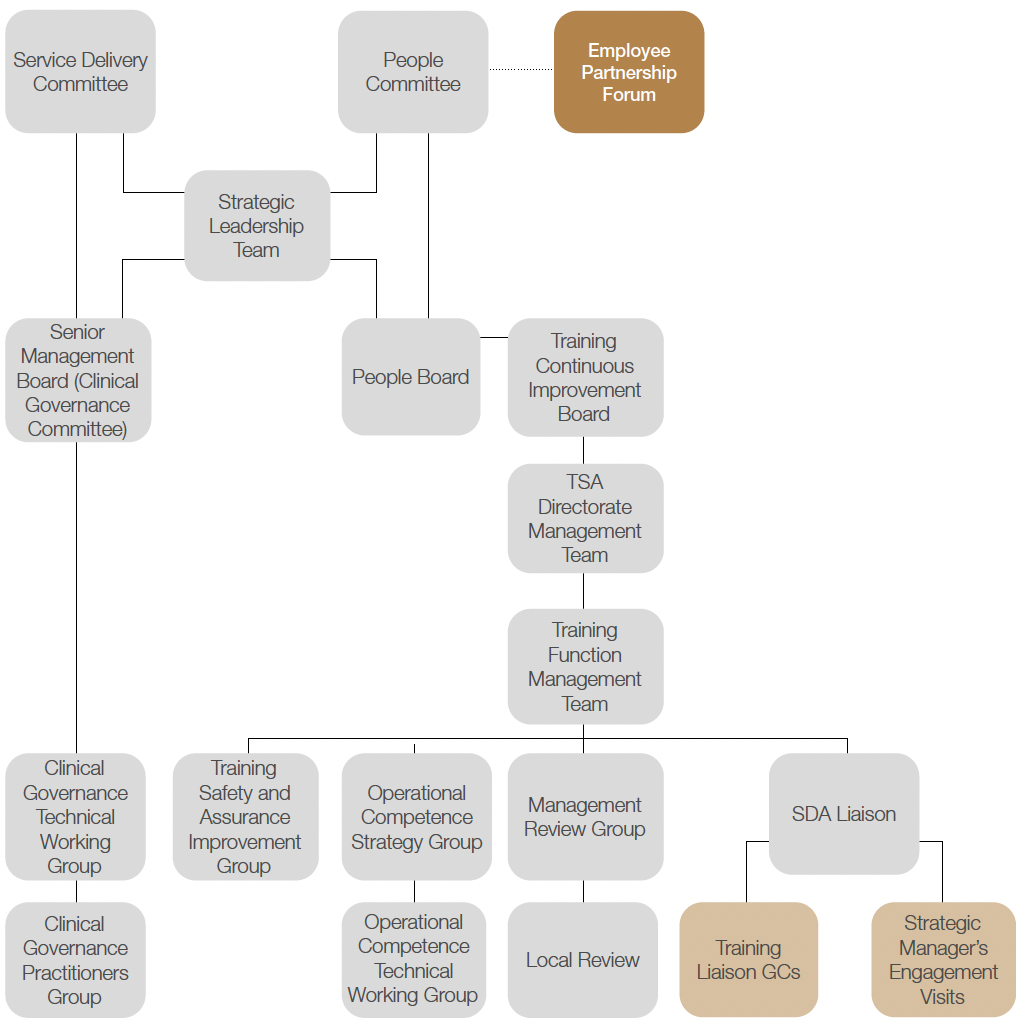
98. Training performance is monitored Service-wide utilising the training function governance arrangements[19] detailed in Diagram 1, which illustrate the informed routes for performance reporting. The TMT provides an informal forum to discuss training activity and performance. The FMT offers formal oversight of business matters and performance. The Training Director chairs the monthly DMT, which reviews Directorate business and monitors performance against indicators. Additional performance monitoring occurs through the Training Safety, Assurance and Improvement Group, OCSG and MRG before matters reach the TMT. Training performance reports are submitted quarterly to the Training Continuous Improvement Board.
Diagram 1 - Training function governance arrangements
99. It is understood that LSOs have scheduled management meetings within their area and that training performance reports are provided for management assessment. Performance dashboards are regularly circulated and made available to managers at LSO level to help them manage, support, and develop operational personnel. Reports for all relevant stakeholders include data sets aligned to KPIs over that reporting year. Relevant training function middle managers and the identified LSO SPOC liaise on a quarterly basis to ensure the TNA is being progressed and checking that there are no issues locally relating to training delivery.
100. Training function strategic managers also liaise with SDA training SPOCs for each SDA on a quarterly basis as necessary, to discuss any issues and also good practice. In addition, there is also a requirement for middle managers responsible for local Training Centres (TC) to liaise with LSO management teams to discuss performance issues on a routine basis. Performance is therefore being monitored on a regular basis by station and/or watch based managers, LSO management teams and TC SCs. This supports the functional commitment to achieving agreed competency rates as well as forming a measuring tool.
101. We found both functional and LSO senior management teams to be very aware of the need to monitor performance. We also found that meeting structures for doing this were very mature, albeit quantatively based. That said, we found most supervisory managers to be unaware of the need to monitor training performance and that performance was routinely viewed as supplementary to the role.
Quality Management
102. A QMS is a formalised system that defines and documents an organisation’s processes, procedures and responsibilities for achieving quality policies, practices and objectives. It helps an organisation coordinate and direct its activities to meet customer and regulatory requirements, as well as continually improve its effectiveness and efficiency.
103. The training function have a QMS Quality Policy[20], which details relevant aspects of the training function such as:
objectives;
structure;
course design;
resourcing;
infrastructure;
processes and procedures;
review; and
measurement and analysis process.
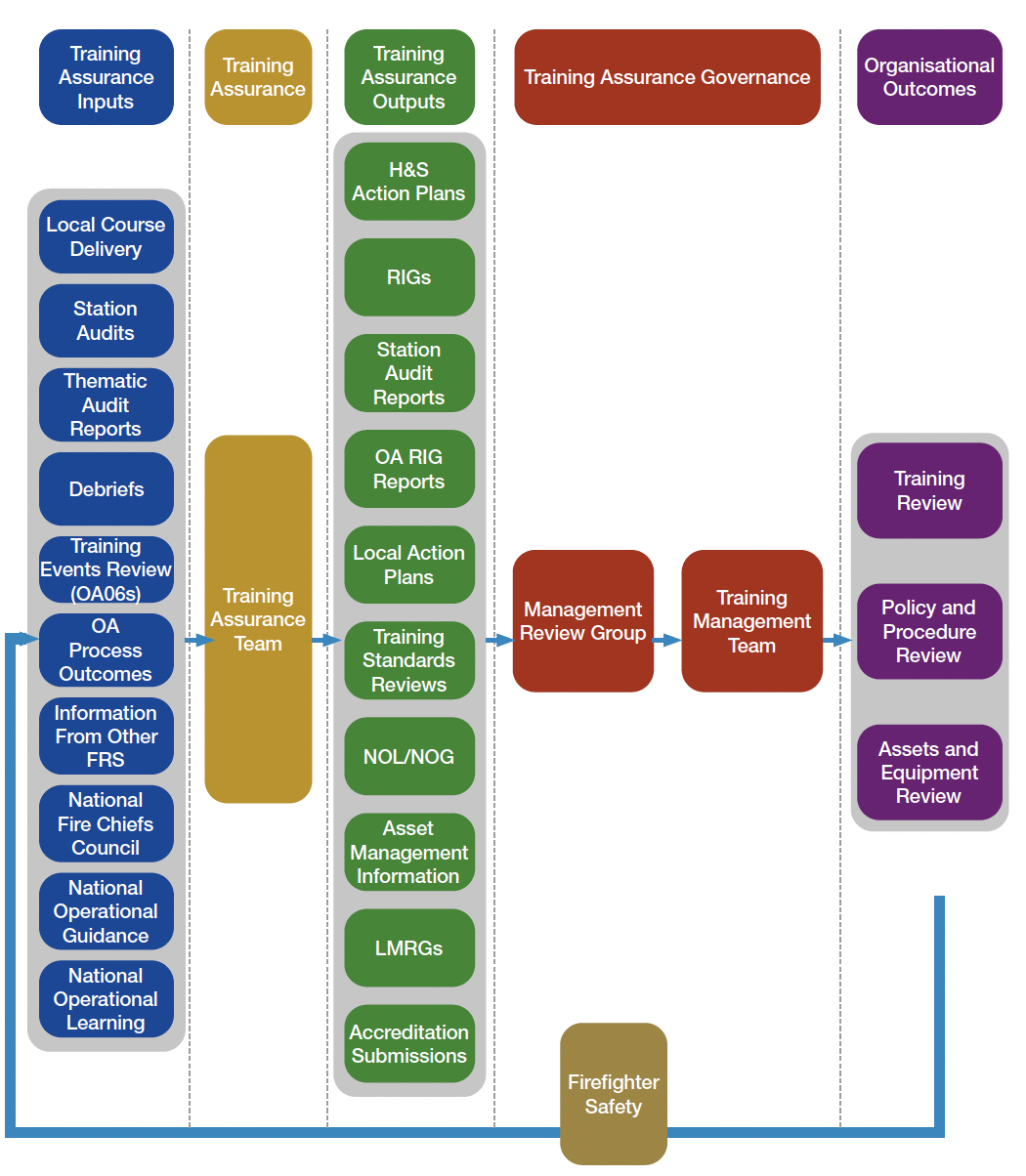
104. The QMS assurance process details that it is predicated on a series of inputs which are monitored and developed by an assurance team to build outputs. These outputs are then analysed and assessed firstly by the MRG and then the TMT, hopefully culminating in improved outcomes as per Diagram 2 below.
Diagram 2 - Training QMS assurance process
Diagram 2 - Training QMS assurance process
105. In particular, the training function employ and are certified to the International Standards Organisation (ISO) 9001:2015 as part of their QMS. We observed reports that demonstrated audits had been conducted, the scope of the audits and that non-conformance to the standards that had been noted. This particular output demonstrated that training should be delivered to an agreed standard and that it is being monitored for any drop in that standard, which was positive to note. It is understood that the number of these inputs and outputs in the assurance process is very comprehensive, which in theory should provide the MRG and TMT with a fully accurate picture of quality and performance generated by the QMS.
106. The training function issues a customer satisfaction survey to all course attendees. Previously paper-based and completed before leaving the venue, it was reported that the system often produced skewed results due to reluctance to give critical feedback and pressure to finish training course attendance quickly. The survey is now issued electronically after the course, resulting in fewer responses but more meaningful feedback. Despite the changes, KPI 29 continues to report of those questionnaires submitted, customer satisfaction levels were close to 100% over the last five years.
107. Whilst this improvement is welcome, previous HMFSI inspections show that staff consistently raised concerns about facilities, course cancellations, equipment, appliances, standardisation, welfare, outdated materials and joining instructions. Whilst the accuracy of the questionnaire data collected is without reproach, this ongoing feedback to inspectors calls the usefulness of this KPI into question, as near perfect satisfaction scores contradict long-standing issues and may provide management with an inaccurate picture. Additionally, many training staff seemed to rely on this metric alone to judge course performance, whereas the achievement of high satisfaction rates should not be the sole indicator of improvement.
108. As detailed previously the training function has a Non-Conformance and Corrective Action[21] procedure that covers the raising, recording of non-conformances and how to initiate and record corrective actions to prevent recurrence. A non-conformance is defined as ‘a failure to meet one or more requirements. These might be training function requirements, procedures, policy, training standard, supplier requirements, candidate requirements or Quality Management System (QMS) standard requirements’ and corrective action is defined as ‘any action deemed necessary to eliminate the causes of non-conformities to prevent recurrence and are appropriate to the effects of the non-conformities’. An example may be the inability to conduct an exercise due to an insufficient number of Thermal Image Cameras. The system is a helpful tool for identifying one off or consistent issues and trends with performance.
109. Although only eight non-conformance reports were submitted in 2024-2025, suggesting most courses ran without major issues, staff consistently reported problems such as outdated or defective appliances and equipment, system failures, limited staff and appliance availability and inadequate welfare and Personal Protective Equipment (PPE) provision. These recurring issues indicate that non-conformance may be significantly under reported and that training delivery is routinely hindered by unresolved systemic challenges. The Service reported that this issue is commonly discussed at management and development meetings to highlight its importance and are attempting to embed an active reinforcement learning and escalation culture.
110. Many staff reported frequent issues that hindered timely and effective training delivery. Although problems were often raised through line management, few seemed to be escalated through the formal non-conformance process. We also noted a strong focus on delivering training rather than improving it, with a limited culture of continuous improvement at instructor level.
111. A British Standards Institute (BSI) assessment report provided by the Service would seem to support this as it details, in respect of the National TC (NTC), the process for non-conformity and corrective action was not fully effective. As such, we concluded that non-conformance is not used extensively to drive performance through the MRG. We believe, there is significant formal under reporting of non-conformance and that the ‘can do’ delivery culture, whilst very commendable, would appear to be inhibiting continuous improvement.
112. The Service employs an OA process that endeavours to manage the quality of operations and encourage all staff, predominantly operational staff, to add to continuous improvement outcomes. The system is also designed to support learning from training and exercising with training deemed to be the acquisition and maintenance of skills and knowledge, whilst exercising is the testing of the skills and knowledge. Our thematic inspection of OA stated that ‘training and exercising would seem to be a proactive process born from the need to learn from how the Service is designed to respond to known incident types. In essence, training and exercising will stress test the equipment, procedures and training prior to attending incidents’[22]. Our report stated that we found almost no evidence of training being debriefed in a format that would formally assist in the improvement process. We recommended that the Service review how and when it debriefs training and exercising to ensure that there is suitable proactive learning to enhance organisational learning.
113. To support this assertion, we observed and were provided with examples of staff identifying potential training improvements but struggling to get them to a forum where they could be assessed for merit. Consequently, we do not believe that the Service, or specifically the training function, are being provided with any meaningful data by staff, which would inform them of potential improvements identified or needed in training.
114. One aspect that seems to exemplify the issues detailed previously is that of standardisation. ‘Standardisation is the practice of establishing and implementing uniform procedures, guidelines, or criteria to ensure Learning and Development processes consistently meet defined quality benchmarks. It provides a structured framework that supports the consistency of processes, outcomes, and evaluations across all aspects of a learning programme…for those who deliver regulated training, standardisation is not optional, it’s a requirement’[23]. Although the Service has policies, procedures, lesson plans, NTS documents and audits intended to maintain consistent standards, several potential factors continue to undermine standardisation. These include; limited capacity, high staff turnover, insufficient staff development, potential cultural differences, geographical challenges and legacy working practices, all of which can negatively affect consistent application of standards.
115. We found that the issue of standardisation was consistently an area of frustration and concern for SD and functional staff alike. Examples of different standards of training between geographic locations, TCs and instructors were cited. Some examples even recounted differing standards being applied within the same training course between the morning and afternoon. Training managers were keen to point out that in their experience training could be delivered differently dependant on factors such as the local work and legacy service culture, background, knowledge, experience and credibility of the instructor.
116. Whilst we accept that these aspects may have merit and a have a bearing on the customer experience, we found that the topics and instances reported to us could not routinely be explained away by this. Some of the standardisation issues referred directly to incorrect application of agreed national standards. To reinforce this position, we found little evidence that training management believed standardisation was an issue for the training function and little evidence of standardisation events being conducted across the instructor cadre that would help to reinforce this aspect of performance.
117. The MRG would seem to be an appropriate forum within the assurance process for assessing quality and performance of training. There is strong evidence that there are inputs and outputs being considered by the training function to identify improvement. However, given our concerns regarding the veracity of customer feedback, non-conformance under reporting, limited OA reporting and standardisation concerns, we believe the effectiveness of this system could be improved.
Recommendation 3
We recognise that the Service has several quality management systems and assurance systems intended to support continuous improvement. However, we found they do not operate cohesively and are not delivering the required improvement anticipated. We recommend the training function should review these systems to ensure they work together as intended.
118. It is worthy of note that the Service has recognised some of these potential deficiencies and has invested resource by transferring a strategic training manager into the Safety and Assurance function. The intent is to refresh and strengthen the approach by developing an overarching assurance framework built around three core elements of Training Assurance, Safety Assurance and OA, with Organisational Learning integrated throughout. The Service has strengthened its assurance function by adding one SC and two WCs.
119. The assurance team is developing a Training Assurance Implementation Plan and has begun reviewing existing policies, procedures, training standards, and the role of the MRG and QMS. Initial inspections and audits at TCs and stations will begin shortly, allowing the team to refine its approach through early learning and feedback. A later phase will introduce independent audits evaluating how training is applied in real operational environments. This direction is encouraging and demonstrates a clear commitment to improving Organisational Learning and training performance.
Audit
120. Audit is quite simply ‘a detailed examination of the quality of something’[24] and can also be defined as the ‘on-site verification activity, such as inspection or examination, of a process or quality system, to ensure compliance to requirements’ and … ‘performance’[25]. As such, it is an integral part of the management of training and a robust programme of audit would be expected. To enable an ethos of continuous improvement the training function detail that a suite of specific training assurance documents and procedures that outline the formal auditing process should be implemented.
121. They state that ‘training audits shall be implemented in due course for training delivery and themed, specific to confirm knowledge and understanding. Competent auditors who have knowledge and experience or access to technical advice of the theme being audited shall conduct the audits’[26]. The functional QMS identifies that the MRG is responsible for ensuring compliance with processes and procedures through regular internal audit and that, where necessary, appropriate risks, threats and opportunities are identified to ensure continuous improvement.
122. The TFF details that, to ensure high-quality and cost-effective training, several processes will be implemented, which are:
TC inspections to identify good practices and address issues;
QMS which includes internal and external audits to monitor adherence to ISO requirements and quality assurance processes;
mechanisms to collect feedback from candidates and instructors to identify improvements; and
governance structures to provide scrutiny and assurance at all levels.
123. From an internal audit perspective, the training function follows a procedure titled Gen 3.2 – Maintaining High-quality Training Delivery[27]. The purpose of the document is to detail the procedure for reviewing and improving the quality of training delivered by training function staff and covers all aspects of training delivery for WT and On Call, driving courses, training carried out within LSO areas and specialist course programmes.
124. Overall responsibility for the procedure lies with the AC (Design and Development). GC and SC managers must ensure compliance at their respective TC locations. For centrally coordinated programmes and training delivered in LSO areas, the responsible SC conducts audits. The GC for quality assurance oversees the procedure’s effectiveness and reports findings to the MRG.
125. At regular intervals, each SC or a nominated competent person must observe a randomly selected training session, theoretical or practical. After observation, the SC completes a training delivery audit form (Gen11) and promptly discusses any findings with the instructor. Any deficiencies should be recorded with corrective actions, followed by a timely recheck to ensure they have been resolved. Copies of all Gen11 forms must be available for internal and external audit.
126. A further review should then take place as soon as practicable to ensure the deficiencies have been resolved. The SC should review, on a continuous basis, the course evaluations completed by all students at the end of courses and discuss with the GC any trends or deficiencies that may be observed.
127. Training management provided examples of completed Gen11 audits, demonstrating that audits form part of the performance process. However, during our inspection, we found little evidence that this procedure is applied routinely; almost no staff interviewed recalled being audited. We also found no evidence of its use within LSO areas or for external courses. Additionally, the requirement to conduct audits at ‘regular intervals’ is vague, and this lack of clear expectations may contribute to the limited application of the procedure.
128. There was concern that limiting audit responsibility to the SC creates a risk of insular practice. Although peer-to-peer reviews were reported and potentially offered useful 360-degree feedback, they operated more like informal debriefs than true audits. While this approach is positive, it is insufficient as the sole method of quality assurance and many instructors did not recognise its limitations.
129. As such, we found the concept of this document to be well founded and that it sets out a desire for auditing the quality of training being delivered by instructors. However, the limited application of the procedure we observed, as well as other inhibitors, was disappointing. Consequently, we believe that a real opportunity to improve performance within training is being missed.
130. We found a programme of TC inspections in place, with the 2024-2025 schedule completed and around half of the 2025-2026 programme underway. Inspections are to be conducted internally by two SCs from outside the host TC and cover key areas including resilience, training delivery, H&S, people, as well as staff knowledge and understanding. Specifically, they inspect:
resource maintenance;
PPE maintenance;
equipment maintenance;
maintenance and awareness of operational and other service issues;
TC and ancillary equipment subject to regular checks;
TC workforce planning and availability of personnel;
TC process to monitor and maintain appropriate documentation;
Covid19 Workplace Risk Assessment and Management Plan completed and reviewed;
TC staff maintaining a record of their competences or development;
personnel in development phase receiving support and mentoring:
reporting and monitoring of H&S events;
H&S records being maintained;
managing attendance process effectiveness;
career management process effectiveness;
TC has an appropriate distribution of skills and personnel availability;
monitoring of TC stock, consumables and inventory process;
TC personnel knowledge and awareness of SFRS objectives, policies and procedures; and
performance information made readily available to personnel.
131. The current inspection programme is comprehensive, but its peer review nature may limit independence and risk bias. In contrast, the SD Community Fire Station inspection model uses a GC as lead, providing stronger impartiality and may be more suitable in this instance. The existing process focuses heavily on maintenance standards, procedures, documentation, workforce planning and staffing, which supports improvement. However, it does not assess the quality of actual training delivery standards, leaving a significant gap in assurance.
132. The Service employs two specific OA audit processes for stations, which are the pre-incident Community Fire Station audits as well as pre-incident thematic audits. The former is administered and managed by LSOs whilst the latter is administered and managed by the TSAB. The Community Fire Station audit and inspection programme measures pre-incident station preparedness and is designed to complement the ‘during incident’ and ‘post-incident’ review processes within the OA system. Elements of the pre-incident station audit include training but are limited to record inspection and a practical demonstration.
133. We concluded from previous inspections that a notable practice within the audit process is that station personnel are required to demonstrate both core practical and technical skills through a training scenario selected from the FRS Manual: Volume 4 – Foundation Training and Development. We stated[28] that ‘the practice of physically demonstrating operational competence for the audit is extremely important and there is an argument that it could form a larger part of the audit. Staff generally had the opinion that this part of the audit was frustrating and that routinely conducting a ‘standard drill’ as defined in the manual may not significantly improve standards….there was general agreement that other operational preparedness could be audited’ as well.
134. We found that the Service had conducted very few thematic audits and none specifically for training. We detailed that there is a need for regular thematic audit in some format as it can focus on routine trending issues and provide recommendation for improvement. As such, we recommended that the Service should consider conducting more thematic audits as the recommended changes from robust data analysis are tangible and can be aligned to continuous improvement. Consequently, we do not believe that the specific training audits of the OA system is driving strong improvement within training or within SDAs. We believe the positive direction of travel and subsequent action plan developed by the SFRS as well as changes to the OA team in response to our OA thematic inspection should improve this situation, if completed.
135. A BSI audit evaluates an organisation’s compliance with standards such as ISO 9001, assessing whether systems and processes meet regulatory, quality and efficiency requirements. The SFRS has an established programme of BSI audits, with evidence of both completed and planned assessments. We were also advised that Driver Training Centres and examiners undergo regular external audits by the Driver and Vehicle Standards Agency, which staff believe helps maintain high standards in that area.
136. The Service has the right audit procedures on paper, but implementation is weak and inconsistent, meaning training delivery quality is not reliably assured. TC inspections are happening, but they focus on facilities, not instructional standards. Limited thematic auditing and under use of existing procedures mean the organisation is missing opportunities to learn and improve. The audit framework is well designed but poorly applied, leaving a critical gap in the quality assurance of training delivery.
Area for Consideration 6: The training function should consider reviewing and reinvigorating the audit processes to ensure that they are receiving maximum information for continuous improvement.
Benchmark
137. It is clear that the training function is part of the process for utilising information from throughout the UK via NFCC National Operational Guidance, National Resilience and NTS, which helps to inform training delivery and development. Other examples of benchmarking include:
utilising NFCC National Operational Guidance and The Road Safety Act 2006 draft regulations as benchmarks for Driver Training Standards;
visits to other UKFRSs have been undertaken by the BA Group, notably to South Wales, Bedfordshire, Durham and Darlington and Greater Manchester FRS to benchmark BA, Compartment Fire Behaviour Training (CFBT) and Tactical Ventilation. These visits have involved comparing syllabuses of courses, delivery methods, facilities and processes for managing contaminants;
benchmarking extrication NTS is currently underway as part of a comprehensive review of extrication training across the Service;
examining the alignment between existing RTC operator and RTC instructor qualifications and the United Kingdom Resue Organisation / NFCC Extrication Competency Framework. Development pathways for all extrication related skills are also being benchmarked against external providers, particularly United Kingdom Resue Organisation; and
engaging in the ‘EXIT’ project, which aims to evolve current extrication practices with a stronger emphasis on casualty experience and clinical outcomes. As part of the EXIT project, training and guidance are being benchmarked against contemporary research, with ongoing collaboration between the Service and the Scottish Ambulance Service.
138. We were also informed that the training function has been represented at the Emergency Services Training Collaboration Group, NFCC Driver Training Advisory Group, the NFCC Tactical Firefighting Group and the NFCC Operational Training and Education Group which allowed for a degree of benchmarking by meeting attendance. We found good evidence that benchmarking was a tool being routinely utilised by the training function to compare the standard of training against other UK FRSs and organisations.
Good Practice 3
The training function has worked hard to develop relationships within the UK FRS. They have proactively used these relationships to benchmark aspects of training to identify continuous improvement and should be commended for this. They should continue to look for opportunities to benchmark training for all aspects of operational training.
Scrutiny
139. The PMF[29] identifies training as a corporate governance matter embedded within SFRS structures, including the Board, its sub committees and the Strategic Leadership Team. Scrutiny takes place quarterly at the Board and People Committee, and every six months at the Strategic Leadership Team. The PMF also notes the TVS as a further source of assurance. Training is regularly scrutinised through quarterly and annual performance reports to the Board and People Committee, combining quantitative KPIs with qualitative commentary.
140. In 2019, the training function reviewed the development of SFRS operational staff, producing 56 recommendations for the TCIP. The programme has since expanded, with the 2023 TCIP Action Plan updating all outstanding actions, assigning ownership to functional leads, and establishing a process to capture new improvement recommendations. The Action Plan is maintained as a live document, with updates reviewed at TMT meetings. There are currently 78 recommendations: 70 completed, seven in progress, and one discontinued. The training function remains responsible for progressing the eight outstanding items, and these are monitored through TSA governance and scrutinised by the Training Continuous Improvement Board, TSAB and People Committee.
141. In summary we found the performance of training to be proactively managed with good quantitative measurement, which is monitored and scrutinised in a mature structured way. We also found that the training function employed a QMS, accredited to an ISO standard, which appeared to be maintaining and driving standards. However, we found that issues with customer satisfaction measurement, under reporting of non-conformance and standardisation all highlighted that the process may not be as effective as it is believed to be. In addition, we also found significant gaps in the provision of audit, which should be addressed.