
Operational Training and Development in the Scottish Fire and Rescue Service
Related Downloads
Operational Training - Management
20. The Health and Safety at Work Act 1974 (HSAW) provides the legislative framework for occupational Health and Safety (H&S). The legislation sets out the statutory duties on both employer and employee in relation to H&S at work. This includes a duty as an employer to ensure, so far as reasonably practicable, the health, safety and welfare at work of all its employees. Additionally, employees have a duty under the act to take reasonable care for their H&S and to cooperate with the employer to comply with their duties.
21. Specifically with regards to training, the Service has a duty within the act to provide training for all operational personnel to maintain them as safe and effective in their respective roles. There is a general duty on the SFRS in respect of ‘the provision of such information, instruction, training and supervision as is necessary to ensure, so far as is reasonably practicable, the health and safety at work of (their) employees to cooperate in fulfilment of that duty’(7).
22. The Fire Standards Board is an independent body which oversees the identification, organisation, development and maintenance of professional standards for Fire and Rescue Service (FRS) in England, with the National Fire Chiefs Council (NFCC) as an integral partner. As a member of the NFCC, the SFRS has access to these agreed professional standards. In relation to OTD the Fire Standards Board details that there is a requirement to meet a standard for leading the service, leading and developing people as well as operational competence. In relation to leading the Service they detail that an FRS should have ‘leaders at all levels’[8].
23. In respect to leading and developing people the standard states that a FRS should ‘train and develop employees, including leaders, so they are competent in their respective roles; provide continual professional development to employees, including leaders, so competency is maintained and developed; identify, encourage and nurture talent, providing career pathways for all; and nurture, develop and prepare leaders as they progress within the organisation’[9]. Lastly, in relation to operational competence the standard details that a FRS should ‘base its training for operational and fire control employees on NFCC Operational Guidance and Fire Control Guidance; and train its operational and fire control employees so they are competent to carry out operational activities safely and effectively’[10].
24. The United Kingdom (UK) national standards for operational response are published by the NFCC on the National Operational Guidance website. This guidance is the basis for all SFRS operational procedures and internal guidance on operational subjects. This guidance is used to formulate SFRS policy and procedures as well as their training standards and is followed by default in the production of all TfOC training material.
Strategy
25. The SFRS Training Vision and Strategy (TVS) 2023-2028 details that it fully supports the intended outcomes of the SFRS strategic plan 2025-2028, aligns to the SFRS long term vision and supports the training functions journey of continuous improvement. The TVS is to provide ‘clarity and resources to ensure we work safely, collaboratively and progressively to deliver excellence in operational training’[11]. It details more specifically that the training function will:
provide clarity and direction on how training will be delivered, who will deliver it and when it will be delivered;
ensure the appropriate resources are made available to deliver training through a flexible delivery model, to ensure that we deliver training in the most effective and efficient way;
ensure training is delivered safely;
work collaboratively with all stakeholders ensuring cross-directorate engagement to deliver the training ask of the Service and embed a culture of collective responsibility for training across all levels of the Service; and
work progressively to ensure we continually explore new ways of working as part of our commitment to continuous improvement.
26. It also details that the TVS will be delivered to ensure, that the four operating principles, set out within the SFRS long term vision, of progressive, people-centred, inclusive and connected are at the heart of all they do. The strategy details that its implementation will ensure that a blended learning approach, including realistic acquisition, refresher training and continued application of the TfOC framework, meets the organisational training need of the SFRS and ensures staff are suitably trained to safely respond to incidents.
27. The TVS ‘on a page’ (Appendix 2) details the component parts of the Training Needs Analysis (TNA) cycle and states that areas of focus for the training function should be to:
develop individuals, teams and training instructors;
create capacity;
provide training delivery infrastructure;
be progressive and innovative;
recognise and appreciate our people;
continue to deliver our training continuous improvement programme;
define operational training related roles and responsibilities;
continue to build a positive and inclusive culture;
be service delivery led when providing training;
be centrally co-ordinated and locally delivered; and
be engaging and connected.
28. The TVS is a user-friendly document which is available on the SFRS intranet site for all staff reference. This clearly demonstrates a link between organisational strategy upwards and delivery downward. The document sets out clearly the ambition of the organisation and senior training managers over a five-year period. Staff within the training function are generally very aware of the document and frequently fed back that it is used by senior management at functional engagement and communication sessions. Awareness of the document outwith the training function tended to be limited to more senior Service Delivery (SD) managers. Its use in day-to-day training development and influence on daily management throughout the organisation appeared to be extremely limited, this may be a reflection of it being a strategy rather than a document for everyday reference.
29. The Service believes that the document was developed in robust consultation and engagement with SD partners predominantly, as proposed changes could potentially have had a direct impact on the local management of training within the SDAs. Some members of SD staff we met, believe the consultation outcome and in particular proposed localised changes were not positive and have yet to be convinced that the aspirations of the TVS have been realised. In addition, many staff believe the TVS to be overly ambitious and that it has not improved training within the SDAs since its publication. As such, winning the hearts and minds of the SD staff would seem to be ongoing and further engagement may be appropriate to illustrate the benefits.
30. On balance, we found the TVS to be a well-constructed document that sets out a five-year plan, which is only partially complete. Senior management within the training function appeared committed and engaged to the vision, which is providing a clear roadmap for the focus of their ongoing investment and management. The Service believes that the TVS will ensure appropriate resources are made available for training and that there has been significant work done to increase capacity and efficiency in delivery that evidences progress toward this. In time it is hoped that they will be able to demonstrate its benefits fully to those still unconvinced.
Good Practice 1: The development of a clear vision and strategy for training within the SFRS is a positive development and staff should be commended for providing this strong leadership.
31. To deliver and resource the strategy, it was originally envisaged that three frameworks called Skills Maintenance, Training Delivery and Training Assets would be developed. In practice, one holistic document was developed, encompassing all three aspects and was named the Training Function Framework (TFF)[12]. The purpose of the TFF was to signpost the underpinning operational competence, standards, delivery models and resources required to deliver training outcomes. It is intended to provide a comprehensive approach to developing and maintaining the skills and competencies of SFRS personnel, ensuring they are well equipped and trained to perform their crucial roles safely.
32. To achieve this the TFF has been aligned to the guidance model contained within the Health and Safety Executive (HSE) publication Health and Safety Guidance 65 (HSG) - managing for health and safety. It is known as the ‘Plan, Do, Check, Act’ cycle, which is structured to encourage continuous improvement. It is our intention to explore many of these aspects throughout this report. The main elements of the cycle in relation to OT are:
Plan
Standards / Expected Outcomes
TNA
Do
Training Delivery
Skills Maintenance
Training Assets
Check and
Quality Assurance
Responsibilities
Performance Evaluation
Act
Governance and Continuous Improvement
Performance Improvement Plan
33. The TFF is available on the SFRS intranet site for all staff reference and is signposted as the enabling document for the TVS. Staff within the training function are generally aware of the document but frequently fed back that it is not something they would generally reference day-to-day. Again, awareness of the document outwith the training function tended to be limited to more senior SD managers.
34. Its use in day-to-day training development and influence on daily management throughout the organisation appeared to be limited. We found the link to the HSG model encouraging and can understand the signposting to many of the different aspects. However, as an enabling document to the TVS it seemed to lack the depth to clearly demonstrate how all the aspects of training fit together, to ensure continuous improvement, and may be one reason why staff do not routinely use it to drive the way they work.
Area for Consideration 1: The Service should consider reviewing the training function framework to better demonstrate the link between the training vision and strategy and training policies, processes and procedures.
Policy, Process and Procedures
35. The SFRS H&S policy[13] details that the Service is ‘committed to the continual improvement and compliance with its legal duties under the HSAW, and other supporting regulations, to ensure the safety of…staff and others who may be affected by…activities in the communities we serve’. To achieve this, the SFRS has developed a TfOC policy[14] which details that ‘the outcomes and operating principles found within our Training Vision and Strategy and will be applied using procedural notes for distinct roles within the organisation. This will ensure that the blend of technical and practical training is of a high standard and is available for all operational roles. This policy will also support the development of our Skills Maintenance Framework, ensuring that these two documents align.’
36. The following generic three-step process is the foundation of the TfOC system:
Step 1 – New Skill (or Role) Required – this process will involve selecting individuals based on service needs to achieve SFRS Target Operating Model (TOM) and/or to acquire specialist skills as identified by the TNA;
Step 2 – Acquisition Training – this will be the initial piece of the training process, designed to equip the selected candidate with the new skills, subject matter area or role to successful completion. This training can encompass a combination of both practical and theoretical components, self-directed study, remote e-learning, or a mix of these methods; and
Step 3 – Maintenance Training – once the candidate is deemed competent in role, they will enter the maintenance phase. This phase will include the training required to keep the skill, subject matter area or role current. Activities to be conducted and recorded can be practical training courses, exercises, theoretical self-study, or e-learning. To maintain currency of competence each activity will be required to be repeated at a minimum frequency, typically a 36-month cycle.
37. In addition, to the TfOC policy, the training function has developed a number of policies, procedures and guidance documents that support training processes. It is not the intention to specifically detail these other documents in this section but to signpost that the most relevant to this inspection will be discussed later in the report. It is noted that Service documentation indicates a strong link between relevant statute and standards with the inclusion of a learning ethos in strategy, policy, process, models and procedures. This whole structure would appear to provide a positive foundation for the management of OT.
Governance
38. The training function has published a Training Function Governance Arrangements document[15], which details ‘arrangements and processes in which the business will be managed together with the authorisation and consultation/engagement processes which underpin them’. The document goes on to detail the structures and work streams such as the Training Management Team (TMT), Functional Management Team (FMT), Directorate Management Team (DMT) and the Training Safety and Assurance Board (TSAB). In addition, it also details the communication, review and engagement processes for SDAs as well as employee and H&S representatives.
39. HMFSI inspectors observed that there is a linear process for routinely managing OT input and outputs to achieve improved outcomes. Most commonly, there are informal meetings held between teams and their supervisory and middle managers on a daily and weekly basis, as part of normal management process. This process is then formalised firstly through the TMT, which is then reported through the FMT. The FMT subsequently reports to the DMT and ultimately to the TSAB. For scrutiny purposes, the TSAB reports to the Strategic Leadership Team via the People Committee.
40. The purpose of the TMT meeting is to provide an informal forum in which to discuss work of the training function including reviewing tasks and functional activity in order to provide support where needed. The TMT is chaired by one of the functional ACs and we understand that the membership has recently been expanded to include all middle managers. The scope of the TMT includes responsibility to manage and co-ordinate the day-to-day business of the training function, provide updates from SFRS governance meetings attended by the ACs and HoF, as well as carrying out a review of actions, including self-audit.
41. The purpose of the FMT is to support objectives of the TSA Directorate in line with the TVS, SFRS strategic plan and Annual Operating Plan. FMT meetings provide a formal forum for the consideration of business, review of performance and discussion of the work of the training function. The FMT is chaired by the HoF. The scope of the FMT includes, but is not limited to:
regular review of performance and progress against the Performance Management Framework (PMF);
monitoring progress of business aligned to the TVS;
review, agreement, scrutiny and implementation of training function business, including policies and procedures; and
supporting the management of risks contained within the TSA directorate and training function risk registers.
42. The purpose of the TSA DMT is to support the development and implementation of objectives contained within the SFRS strategic plan and associated Annual Operating Plans. TSA DMT meetings provide a formal forum for consideration of business, discussion, monitoring and review of performance against agreed directorate and SFRS key performance indicators on a regular basis, and identify areas for improvement in line with TSA and SFRS priorities. The DMT is chaired by the TSA Director. The scope of the TSA DMT is to:
undertake a strategic review of TSA performance to ensure the delivery of appropriate standards;
provide visible leadership to promote positive behaviour within TSA; and
review TSA policies and procedures.
43. The TSAB provides a forum where the strategic review of operational performance is undertaken. The purpose of the TSAB is to support the SFRS in meeting its statutory obligation in relation to H&S both in the operational and non-operational environment and to support the continuous improvement of training delivery within SFRS. It should be noted that at the time of publication the Service confirmed the intention to dissolve the TSAB with the creation of a leaner governance structure and Strategic Management Board. We note that the TSAB has been a successful forum for managing training issues and hope that the Strategic Management Board is equally successful.
44. Middle managers from training and their corresponding Local Senior Officer (LSO) Single Point of Contact (SPoC) are scheduled to meet as a minimum, on a quarterly basis, to ensure the TNA is being progressed with no issues relating to local training delivery. Training function ACs meet with the designated SDA training SPoC quarterly or as necessary, to discuss any issues, challenges and good practice. Training function ACs, accompanied by the Training GC SDA liaison, meet individually with each LSO on an annual basis. These meetings are intended to be informal, however, notes of any relevant discussion points are captured and circulated by the training function. Staff reported that these meetings generally happened and there was regular engagement between all operational workplaces.
45. In addition to these standard governance meetings, we also found that there were numerous other strategic, working and practitioner groups that complimented the governance and management of the training function. Examples of these included the Operational Competence Strategic Group (OCSG), the Management Review Group (MRG), the Operational Competence Technical Working Group and the Breathing Apparatus Practitioners Group. It is not the intention to specifically explore these other fora in this section but to signpost that the most relevant to this inspection will be discussed later in the report.
46. It is important to note that the training function participate in the risk management process for the Service and have identified a risk of a potential inability to maintain or improve training delivery due to insufficient capacity being available within the training function to meet current demand. They note that this could result in current and future negative impact on currency in operational skills and capacity, associated legal and regulatory compliance and financial and reputational cost.
47. In addition, they also detail that there is a risk of an inability to maintain or improve training delivery due to the limited finance/budget available for capital investment, condition and location of the training estate and therefore lack of access to appropriate facilities. They believe this could result in current and future negative impact on currency in operational skills and capacity as well as associated legal, regulatory, compliance, financial and reputational cost. The Service notes that there are a number of control measures and mitigations to both these risks now in place, with many addressed throughout this report.
48. During the course of this inspection, we observed that the Service has a mature formal OT governance structure that is used for both internal and external information input and output management. It involves clear scope, lines of reporting as well as key stakeholder and business partners who can contribute and engage at an appropriate level. Action plans and responsibilities are developed and monitored to ensure the effective management of tasks and timelines.
49. HMFSI found that although structured formal governance operated effectively between strategic and middle managers, the informal weekly meetings between middle and supervisory managers seemed to be very sporadic and infrequent in nature. Many staff reported that they rarely came together as a group or team to discuss functional business and were generally unaware of the genesis of decisions or tasks. The main reasons cited for this, was generally the pressure of workload, scheduling, capacity, managerial style and sometimes geography. We found that these pressures resulted in managers finding it difficult to invest time in good communication, governance and engagement with staff, resulting in a level of detachment from the TVS.
Area for Consideration 2: The training function should review its governance process to ensure there is robust communication and engagement processes between middle management, supervisory management and the teams below them in the structure.
Systems
50. The Learning Content Management System (LCMS) is a platform hosted on the Service intranet, used by SFRS to facilitate the management and delivery of training materials and e-learning resources. This system allows for the creation, storage and distribution of educational content tailored for firefighters and other emergency response personnel. It supports various learning modules, assessments and resources that are essential for ongoing and development within the fire service. The material and learning resources aligned to the TfOC system are all hosted on the LCMS, which is available Service-wide. Training function managers can monitor the information input and are able to extract data for assessment and analytics.
51. PdrPro is a training and competence management and recording system, purpose-built for FRSs’, access is gained via unique internet login details to the host company's platform. PdrPro helps track, manage and develop competencies for firefighters and the Service has adopted a suite of products and services, including the LearnPro Learning Management System and pdrPro Competency systems.
52. This provides a robust, role-based framework that ensures every team member, from frontline firefighters to specialist operators, maintain the skills, certifications and readiness required to respond safely and effectively. All learning and development outwith the TfOC LCMS system is managed and recorded on pdrPro. The implementation of pdrPro has enabled SFRS to move away from paper-based tracking to a digital system. Since its introduction, pdrPro has become a cornerstone of the SFRS’s learning and development strategy, helping the organisation to deliver training solutions for all operational staff.
53. In addition, to these two main systems, the training function also uses Microsoft based software applications both nationally and locally to manage the TNA, course scheduling, course planning, venue bookings etc. The three systems detailed do not interface with each other particularly well making control and coordination very cumbersome, which requires a great deal of manual intervention. Staff reported that these issues made their role less effective, inefficient and open to human mistakes.
54. These issues are further compounded by the fact that interface with the People Directorate systems is also limited. This creates difficulties in the coordination of competencies and skills for workforce planning across the two directorates as well as SDAs. HMFSI is aware that the SFRS Strategic Service Review Programme embarked upon delivering the People Payroll Finance and Training (PPFT) project to deliver a joined-up software system.
55. The training function collaborated with the wider PPFT project to explore the potential for interlinking systems across the SFRS. This work involved gathering requirements and evaluating a range of vendors who might be able to meet those needs. However, the Service ultimately concluded that the specific requirements of the training function could not be fulfilled within the scope of the PPFT project. It is worth observing that we highlighted in our culture thematic inspection, potential failings of the business case and system specification process for the PPFT. The Service has subsequently reported that the PPFT project has been terminated following exploration of shared services with Scottish Government, a new outline corporate system business case has been approved, and a project established.
56. As a result, the training function has initiated its own procurement process to identify a system that better aligns with its needs and can integrate effectively with other relevant SFRS systems. They believe this independent approach offers a clear advantage in that it increases the likelihood of securing a solution that fully meets the training function’s requirements. It is hoped that this would avoid the compromises necessary if had it remained within the broader PPFT framework.
57. Reports from the Training Continuous Improvement Project (TCIP) have detailed that the desire is to ensure that training, planning and recording systems are procured, interlinked and that compatible databases are utilised to avoid duplication of data inputs. Reports from the TCIP also detailed that the project team wish to support the SFRS’s digital strategy to ensure that electronic systems are interlinked and that compatible databases are utilised to avoid duplication of data inputs e.g. iTrent, Gartan etc. Senior managers within training are confident that a new training software package will be delivered in the near future and will make improvements.
Area for Consideration 3: The training function should ensure that the new software system currently being procured can interface with the new people software system to guarantee that effective and efficient coordination of development, competencies, skills and subsequent workforce planning can be achieved.
Structures and Administration
58. In many organisations, which have responsibility for their own training, there exists a simple relationship between, those requiring training and the person responsible for training delivery. In this model (Figure 1) anyone requiring training for their staff would be classed as the ‘Customer’. The person with responsibility for training, the HoF, would be classed as the ‘Supplier’. Ordinarily the Customer identifies what training they require and discusses this need to the Supplier. The Supplier then determines how best this need can be met and either, designs and delivers an internal solution, or procures a suitable product from a third party ‘Provider’. Like all good suppliers they should, of course, ensure the customer is engaged in this process and is satisfied with the proposed solution. As detailed previously there is evidence to suggest routine scheduled SD engagement to discuss and agree their training needs.
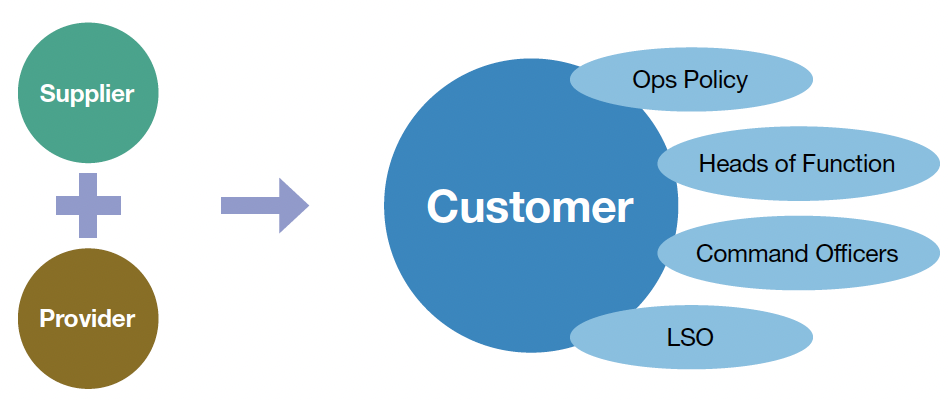
Figure 1 - Traditional Training Model
59. SFRS would seem to follow this basic model and in respect of OT the customers vary and include operational policy developers, LSOs, HoF and command officers. The majority of customers sit within the SDAs and are either station-based or manage and support these stations. Historically, LSOs had dedicated locally based training staff and that would allow them to coordinate and prioritise a degree of local training, thereby having some responsibility and control for supply.
60. However, with the advent of the TVS, these local staff have been brought within the training function and LSOs are now predominantly customers. The training function believe that this model provides a lot more flexibility in the use of capacity and supports their desire to have staff being trained locally but coordinated nationally. It should be noted that the majority of training is delivered internally with a heavy balance of OT being the supplier with limited use of other training providers. The Service do stress that it has attempted to shift away from a traditional supplier/customer model in recent years towards a more collaborative approach which recognises that responsibility for effective training is shared across the organisation at every level of management.
61. The structure and capacity of the training function is built around the TOM concept used throughout the Service and can be roughly broken down by uniformed and support staff as detailed in Table 2 below (all data within the report supplied by SFRS, October 2025). The table illustrates that the current agreed TOM is 245, whilst the Actual staff in post is 214, which is an approximate vacancy rate of 13%. The majority of these vacancies are currently within the WC and support staff instructor posts.
Table 2 – Uniformed Staff TOM and Actual comparison by SDA area
WSDA |
ESDA |
NSDA |
TOM |
ACTUAL |
% |
|
|---|---|---|---|---|---|---|
DACO |
1 |
0 |
0 |
1 |
1 |
100% |
AC |
1 |
0 |
1 |
2 |
2 |
100% |
GC |
3 |
2 |
2 |
7 |
7 |
100% |
SC |
5 |
5 |
5 |
15 |
14 |
93% |
WC |
51 |
22 |
30 |
103 |
88 |
85% |
CC |
29 |
20 |
25 |
74 |
69 |
93% |
SUPPORT |
17 |
11 |
15 |
43 |
33 |
77% |
TOTAL |
107 |
60 |
78 |
245 |
214 |
87% |
62. Within the training function, staff are assigned a post within various different families or teams performing a purpose. Table 3 below demonstrates the TOM and actual staffing comparison by team and post. Many of the families have a relatively small TOM with the actual staff in post figure being either full or in deficit by single digits. However, it should be noted that SDA based instructors had a vacancy rate of 10%, core instructors 14% and driving instructors 18%.
WC |
CC |
SUPPORT |
TOM |
ACT |
% |
|
|---|---|---|---|---|---|---|
Management Team |
0 |
0 |
0 |
25 |
24 |
96% |
Business Support |
1 |
0 |
1 |
2 |
2 |
100% |
Learning & E-Dev |
3 |
3 |
8 |
14 |
11 |
79% |
SMARTEU |
2 |
0 |
0 |
2 |
1 |
50% |
Area-Based Instructor |
23 |
36 |
0 |
59 |
53 |
90% |
Core Instructor |
49 |
24 |
5 |
78 |
67 |
86% |
Driver Training |
5 |
7 |
16 |
28 |
23 |
82% |
Incident Command |
8 |
1 |
0 |
9 |
8 |
89% |
Rope Rescue |
4 |
0 |
0 |
4 |
4 |
100% |
Water Rescue |
5 |
1 |
0 |
6 |
6 |
100% |
Specialist |
3 |
2 |
0 |
5 |
4 |
80% |
Fire Ground Tech |
0 |
0 |
13 |
13 |
11 |
85% |
TOTAL |
103 |
74 |
43 |
245 |
214 |
87% |
63. If management and admin posts are discounted, Table 4 illustrates that the current agreed TOM for instructional posts is 198, whilst the actual staff in post is 173, which is a vacancy rate of 13%. It details that the actual uniformed and support instructional staffing for the WSDA is 75, East SDA (ESDA) is 44 and NSDA 54. This indicates that the WSDA is carrying a vacancy rate of 12%, the ESDA an 8% and the NSDA 17% for instructional staff. It is understood that vacancies are specific point in time and open to fluctuation and recruitment processes on a dynamic basis.
64. Whilst it is difficult to draw conclusions from these calculations alone, it does demonstrate that vacancies within the ESDA seem to be within a more tolerable limit, whilst that of the WSDA and NSDA are more challenging and may indicate pressure on staff and the subsequent delivery of training within the area. The vacancies within the ESDA are predominantly SDA based instructors, the WSDA a mixture of SDA based, core and driving instructors, whilst in the NSDA it is predominantly core and driving instructors.
WC |
CC |
SUPPORT |
TOM |
ACTUAL |
% |
|
|---|---|---|---|---|---|---|
WSDA |
51 |
29 |
5 |
85 |
75 |
88% |
ESDA |
22 |
20 |
6 |
48 |
44 |
92% |
NSDA |
30 |
25 |
10 |
65 |
54 |
83% |
TOTAL |
103 |
74 |
21 |
198 |
173 |
87% |
65. There would appear to be a high vacancy rate within training, which is predominantly driven by unfilled posts at SDA support, core and driving instructor level. The data would suggest that the highest factor is in the NSDA with the WSDA also being affected. We found that the position detailed above mirrored our feedback. Many staff within the training function, detailed that vacancies were a routine issue and had a negative impact on capacity, workload and the subsequent delivery of training. Some reasons for vacancies and staff turnover were cited as retirements, inefficient workforce planning processes, promotion criteria, attraction and marketing, Terms and Conditions (T&Cs) and trouble filling ‘hard to fill’ posts, which are historically those predominantly in remote rural locations.
66. It is noted that the training function has worked hard to streamline T&Cs and to make them uniform across the organisation. A recent change to harmonise these, in particular working hours, has had an impact on training delivery. Instructors are now required to carry out more work nationally, which is reported to sometimes reduce hours available for instruction locally, which can be a source of frustration particularly for station-based support. There is also now a requirement for instructors to provide targeted availability to deliver courses at weekends where necessary, which attracts a salary enhancement.
67. It was also reported that T&Cs do not align to the start and finish times of courses and the goodwill of staff has to be relied upon in many instances to ensure training delivery. This goodwill often comes at the expense of time in lieu leave being accrued by instructional staff, which in turn can impact planning for subsequent training delivery. This situation would seem to be a vicious circle and difficult to manage. The Service detailed a strategic commitment to address additional capacity within training, which will hopefully allow the reassessment of T&Cs in the future.
Area for Consideration 4: The training function should consider the review of its instructor terms and conditions to identify where changes could be made that will ensure more efficient and effective training delivery balanced against staff welfare.
68. On a more positive note, the training function have proactively engaged in workforce planning processes and developed an innovative staffing solution in order to fill routine and/or ‘hard to fill’ posts, with a degree of success. The training function recently introduced new training support CC roles for remote rural areas including on the islands of Western Isles, Orkney and Shetland. These personnel assist with core training work including preparation of trainees for phased assessments, Breathing Apparatus (BA) refreshers, Road Traffic Collision (RTC) refreshers etc. In addition, the loss of the hard border for instructors between training areas, initiated by the TVS, has allowed for more flexibility and support, particularly in the NSDA. These innovative approaches mean a semi-permanent training instructor presence in some of the more difficult to reach areas of the SDA.
Good Practice 2: The training function has worked hard to develop innovative staffing solution for ‘hard to fill’ geographical posts and should be commended for this. They should continue to look for opportunities to ensure quality training is delivered to all parts of the organisation.
69. We were told that staff, predominantly uniformed instructors, were routinely being encouraged to exit the training function, to gain operational experience and gather evidence in order to progress into middle management. It is understood that some staff may need to do this dependent on their prior experience but the advice seemed to be arbitrary with no real evidence base or formal criteria to back it up. This advice seemed to be self-destructive for the training function with the effect of encouraging the transfer of credible, competent and experienced instructors outwards. It is unclear as to the exact origins of this advice but its genesis has been attributed in some part to feedback from interview panels following unsuccessful promotion processes. The Service detailed that it is committed to developing supervisory managers within the function, could not guaranteed progression to middle manager within the same function, for a variety of reasons, on all occasions and that the issue was inextricably linked to the talent management challenges, explored later within this report.
70. In addition, the posting and training of new instructors inevitably causes a lag in training delivery and consequent drop in performance. There did not seem to be a reciprocal process that SD staff should need to seek functional experience for promotion and as such, the constant two-way flow of engaged and motivated staff was not apparent. This issue is not a criticism of training management but more a comment of what would seem to be an absence of guidance on career pathways and talent management within the Service as a whole. We found this overall aspect disappointing and believe that the training function should work more proactively with regard to keeping its best people in place.
Recommendation 1: In the absence of a formal Service career pathway document, we recommend that the Service should consider reviewing guidance and support provided to managers that would proactively encourage the retention and development of staff, to promote continuity within training.
71. The industry standard for the number of training staff to employee ratios for technically based organisations can vary and is not generally stated for UK FRSs . Additionally, we were unable to find an applied model for training staff levels for the organisation, workplaces or SDAs with the structure and numbers assigned seemingly historical and developed organically. The Fire Safety and Organisational Statistics (FSOS) 2024-2025[16] detail that the Service has approximately 7,556 staff of which 6,468 are operational, excluding Operations Control (OC), as detailed in Table 5.
72. Therefore, the TOM training function staff number of 245 would provide a rough overall staff ratio to employees of 1:26. However, if the TOM figure of 198 for instructional staff only was used this would raise the ratio to 1:33. When this is analysed by SDAs, it can be demonstrated that the ratio is fairly consistent and that no one area has a massively disproportionate amount of staff per employee as per the TOM.
Ops staff |
All Function |
Ratio |
Instructor staff |
Ratio |
|
|---|---|---|---|---|---|
National |
6,468 |
245 |
1:26 |
198 |
1:33 |
WSDA |
2,672 |
107 |
1:25 |
85 |
1:31 |
ESDA |
1,569 |
60 |
1:26 |
48 |
1:33 |
NSDA |
2,227 |
78 |
1:29 |
65 |
1:34 |
73. If the same analysis is conducted on the actual training function staff number of 214, it would provide a rough staff ratio to employees of 1:30 detailed in Table 6. However, if the actual 173 figure of instructional staff was used this would raise the ratio to 1:37. When this is analysed by SDAs, it can be demonstrated that the ratio is fairly consistent across the WSDA and ESDA, whilst there is a slightly higher instructor to staff ratio in the NSDA, which is potentially aligned to the higher vacancy rate.
Table 6 – Actual ratio to training function staff
Ops staff |
All Staff |
Ratio |
Instructor Staff |
Ratio |
|
|---|---|---|---|---|---|
National |
6,468 |
214 |
1:30 |
173 |
1:37 |
WSDA |
2,672 |
93 |
1:29 |
75 |
1:36 |
ESDA |
1,569 |
55 |
1:29 |
44 |
1:36 |
NSDA |
2,227 |
66 |
1:34 |
54 |
1:41 |
74. As detailed, there is a directorate identified risk of an inability to maintain or improve training delivery due to insufficient capacity being available within the training function to meet current demand. The training function submitted a ‘Capacity and Resourcing Needs’ analysis paper to the Strategic Leadership Team in January 2025, which details the challenges linked to training function capacity versus predicted organisational training requirements. The paper stated that they conducted a national capacity analysis, as well referring to historic time and motion studies, which sought to map overall capacity against future SFRS organisational training requirements and to then offer recommendations.
75. Their analysis found that job families and commensurate workplaces were generally working over 100% capacity, ranging from 80% to 166%. They found that on average the training function was working at 112% to meet the organisational training requirements. It concluded that there were a number of managerial options for improvement with a subsequent recommendation that between 18 to 20 additional instructor staff would be required to meet the needs. It was pleasing to observe the training function’s focus on developing more capacity as per its commitment in its TVS.
76. HMFSI found that the position detailed above mirrored the feedback provided during interviews. Many staff within the training function, predominantly within the core and SDA support family groups, believed they were working over capacity to get the job done. This resulted in staff not taking their allocated amount of annual leave, having difficulties in reclaiming compensatory leave, sacrificing Continuous Professional Development (CPD) opportunities as well encountering ongoing difficulties in prepping for, assuring and review of courses. This situation was exacerbated by some staff being redirected to work on other Service-sponsored projects or carrying out a dual role. It should also be noted that we found that the capacity of staff carrying out management or development roles to be challenged also, and that this appeared to have a detrimental bearing on training performance management, which will be explored later in this report.
Recommendation 2: We recommend that the Service continue to review its training capacity in line with organisational requirements in order that it can redirect any future additional resources to training delivery and its performance management.
77. The Service historically sponsored the creation of an administrative team called ‘Team C’ who sit within the structure. The team has approximately 13 members reporting to a team leader. They are dedicated solely to the scheduling of training and working across the other staffing teams to minimise the impact of training absences from appliance and command officer availability. Team C perform the training scheduling role and it is far more efficient for instructors not to have to do this. There are other teams that consider operational and FDO cover so there is a need for constant communication and engagement between the teams. Team C reported that systems are ‘clunky’ and they are using an old system aligned to a legacy FRS. Systems do not ‘talk to each other’, which results in inefficiency and potential human error. There is a need for systems to be far more ‘joined up’ so that skills, competencies, capacity etc. can all be factored easily, which the new training software system will hopefully support.
78. The Chief Officer is ultimately responsible for the discharge of the legal obligations that apply to the content of the H&S policy and training. Whilst the Director of TSA is the strategic lead for training and provides strategic direction and policy. The HoF has the delegated responsibility from the Director of TSA for functional strategic management.
79. The TFF details that it is essential for operational station-based supervisory managers to maintain competencies, provide relevant ongoing training and that core skill responsibility lies with:
training instructors – acquisition of skills;
training instructors and operational based supervisory managers – firefighters in development; and
training instructors and operational based supervisory managers – maintenance of skills.
80. The TFF then goes on to detail training responsibilities as:
operational supervisory managers maintain and manage staff competencies;
SPOCs oversee local training compliance and needs; and
LSO SD managers manage station-based staff competence and currency of staff qualifications and skills.
81. It is clear that all staff within the training function were aware of the role that they are carrying out and were clear as to their responsibilities regarding the tasks for actual delivery of training day-to-day. However, we could find no comprehensive list of responsibilities that defines roles from DACO down through the training function, which was confirmed by some staff who were simply aware of the day-to-day task they had to do. We were unable to find further guidance regarding roles and responsibilities and found direction on this area of management to be incomplete and relatively light.
82. We found that many staff were not as clear to other responsibilities, which was particularly stark when questioned about performance management and the review of training. Staff, particularly those below middle management, generally did not appear to place importance on the need for this aspect of their role and seemed solely focused on the task at hand. Whilst it is commendable that staff are very focused on delivery of training, it is also concerning that opportunities may be being missed to change the training function and for continuous improvement because staff have not been directed or developed to appreciate this responsibility.
Area for Consideration 5: The training function should consider reviewing its policies and guidance to ensure that all staff are aware of their full responsibilities and that they are developed to understand and deliver on this.